Studio Shopify Theme Review: Editorial Design That Sells Creative Work
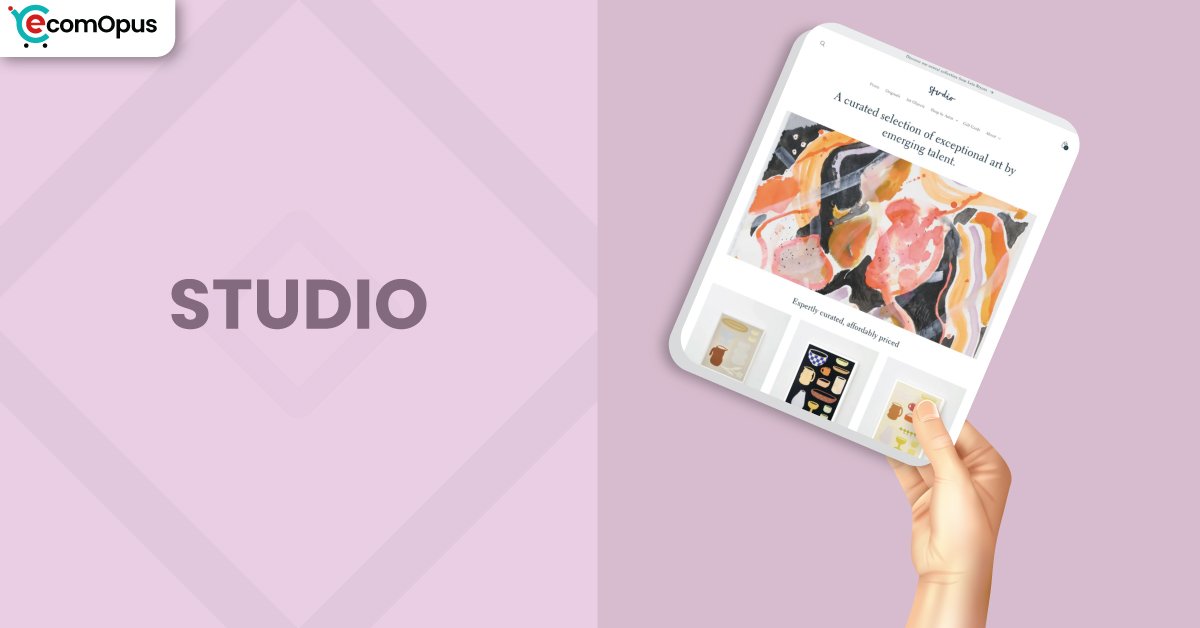
Studio is a FREE Shopify theme built for artists and creators who sell stories alongside products. It pairs gallery-style layouts with practical commerce sections, so stores feel curated without feeling complicated.
- Built for artists, makers, and creators
- Editorial layouts that highlight product storytelling
- Clean navigation with soft, gallery-like rhythm
- Strong section control without heavy apps
- Product pages built for visual trust
- Mobile experience stays calm and readable

Introduction
At Team eComOpus, we tested Studio Shopify Theme like we were launching a real creative storefront, not just clicking around a demo. We set up collections, built product templates, tried blog-style content, and ran a few “would I buy this on my phone?” journeys to see where Studio feels effortless and where it asks for extra attention. One phrase from our notes kept popping up: “The design feels confident and intentional.”
What stood out most is how Studio balances art-forward layout choices with day-to-day usability. The theme tends to reward merchants who keep content tidy, images consistent, and sections purposeful, which is exactly how many creator brands already operate. A merchant described it as “visually STUNNING and IMPACTFUL,” and that matches the overall feel when your photography and typography are doing the heavy lifting.
Ideal For Niches With Supporting Features
Studio Shopify Theme is not trying to be a mega-catalog machine, and that’s a feature, not a limitation. It’s designed to help brands present work with clarity, texture, and meaning, while still keeping shoppers on a predictable path to purchase. The niches below fit especially well because their products benefit from context, imagery, and a slower, more intentional browsing tempo. The supporting features listed are the ones that consistently shape conversion and confidence for these store types.
| Niches | Supporting Features | Why They Matter? |
|---|---|---|
| Art prints and galleries | Editorial sections, image-forward grids | Shoppers want to browse like a portfolio, then buy without friction. Strong visuals reduce hesitation when products are taste-based. |
| Jewelry and accessories | Clean product media, structured product info blocks | Close-up media and orderly details build trust quickly. It makes premium items feel legitimate, even at small-brand scale. |
| Home decor and ceramics | Curated collections, spacious layout, rich content blocks | Products sell better when placed in a lifestyle “scene.” The spacing keeps the store from feeling crowded or discount-driven. |
| Beauty and fragrance | Story-led sections, focused CTAs, brand-first typography | These categories rely on mood and identity as much as features. Studio supports narrative without burying the buy button. |
| Workshops and digital offerings | Page templates, blog-friendly layout, content hierarchy | Services and digital items need explanation and structure. The theme helps you present information without turning pages into walls of text. |
Presets
Studio Shopify Theme is a standalone FREE Shopify theme with no preset variations. Instead of locking you into multiple styles, it gives a consistent design system you can bend using sections, typography, spacing, and color choices. That approach works well for creators because brand identity usually comes from imagery and voice, not from switching the entire storefront personality. If you prefer one cohesive aesthetic across the site, Studio keeps the look unified while still letting you build distinct pages through templates.
Key Features And Highlights
Studio Shopify Theme is strongest when features make daily operations smoother, not louder. It focuses on content presentation, visual merchandising, and flexible layouts that feel “editorial” rather than purely transactional. The table below breaks down the features that genuinely matter once you’re managing products weekly, updating collections, and trying to keep the storefront feeling fresh without rebuilding it every month. These are the capabilities we saw affecting speed of setup, shopper clarity, and long-term maintainability.
| Features | What It Is And Why It Matters? |
|---|---|
| Editorial homepage sections | These sections let you arrange content like a magazine spread, not a template grid. It helps you spotlight collections, stories, and launches without visual noise. |
| Flexible page templates | You can create different page layouts for different needs, like “About,” “Workshops,” or “Lookbook.” This prevents the site from feeling like every page is wearing the same outfit. |
| Product media support | Studio handles product imagery cleanly across common layouts, especially when photos are consistent. That matters because creative brands often sell through visuals before specs. |
| Collapsible content blocks | These keep long product details readable by letting shoppers open what they care about. It reduces scrolling fatigue, especially on mobile where attention is expensive. |
| Blog-friendly styling | The blog presentation feels more intentional than many free themes, with spacing and typography that support reading. This helps brands that use editorial content to drive discovery. |
| Collection browsing clarity | Product grids feel tidy and easy to scan when titles and images are disciplined. It makes collections feel curated instead of cluttered, which supports perceived quality. |
| Strong typography controls | Type choices shape the “gallery” vibe of the store, and Studio leans into that. When typography is aligned with brand voice, the entire site feels more premium. |
| App-light merchandising | Studio can look complete without stacking cosmetic apps on top. That’s helpful because fewer apps often means fewer conflicts and fewer surprise layout shifts. |
| Shopify-native compatibility | Core store functions tend to behave predictably because the theme plays nicely with native workflows. That stability is valuable for merchants who want fewer moving parts. |
Theme Experience!
Studio Shopify Theme is less about flashy motion and more about the feeling of controlled presentation. We tested the theme like shoppers, scanning collections, opening product pages, switching variants, and moving through cart and checkout steps to see where it feels smooth. The table below focuses on experience outcomes, not design theory, because the real question is simple: does the storefront feel trustworthy and easy to buy from? These experience areas are where Studio tends to either feel elegant or expose friction if content is inconsistent.
| Experience Area | What Shoppers Feel In Practice? |
|---|---|
| First impression | The storefront reads like a curated collection, not a random product dump. Shoppers quickly understand the brand’s taste and what category they are in. |
| Product discovery | Browsing feels calm because spacing and hierarchy keep choices readable. When collections are well organized, shoppers explore longer without decision fatigue. |
| Mobile navigation | Menus feel clean and predictable, with fewer “where am I?” moments. The experience improves further when announcements and headers are kept minimal. |
| Collection browsing | Grids look premium when titles are short and photography is consistent. If images vary wildly, the layout can feel less gallery-like and more mixed-market. |
| Product page confidence | Media and details sit in a logical order, so shoppers know what to check next. This helps creative goods feel credible, especially for first-time visitors. |
| Content storytelling | The theme supports story sections without making the site feel like a blog pretending to be a store. Done well, it turns brand narrative into a conversion assist. |
| Cart and checkout flow | The path to checkout stays straightforward and familiar, which reduces hesitation. Small conflicts usually come from apps, not from the theme’s default flow. |
| Visual consistency | Studio rewards disciplined branding with a cohesive “exhibit” feel across pages. If branding is messy, the theme won’t hide it, it will amplify it. |
Performance, Explained!
Performance for Studio Shopify Theme lands in a realistic middle ground: it can feel fast and stable, but it is sensitive to heavy imagery, app conflicts, and overly ambitious sections. On mobile, the Core Web Vitals status shows as failed in the dataset we reviewed, even though key timings like LCP and FCP look quite strong for a visual theme. Desktop fares better overall, passing Core Web Vitals while still reflecting the weight that editorial layouts can introduce. The table below summarizes the practical performance picture in plain terms, so merchants know what they are buying into before adding ten apps and thirty oversized banners.
| Performance Parameters | Mobile | Desktop | Remarks |
|---|---|---|---|
| Performance Score | 73/100 | 71/100 | Mobile performance is respectable for a visual theme, but it is easier to tip into “okay” territory with heavy images. Desktop stays steady even with richer layouts. |
| First Contentful Paint (FCP) | 0.9 s | 0.9 s | Content appears quickly, so the site feels responsive early. This helps reduce bounce, especially when visitors arrive from social links. |
| Largest Contentful Paint (LCP) | 1.5 s | 1.4 s | Primary content loads within strong thresholds, which supports perceived speed. Large hero media can still shift the experience if not optimized. |
| Cumulative Layout Shift (CLS) | 0.00 | 0.08 | Mobile stability is excellent, with minimal visual jumping during load. Desktop shows more movement, often linked to late-loading assets or embedded elements. |
| Interaction to Next Paint | 247 ms | 59 ms | Desktop interaction feels snappy, especially for browsing and quick taps. Mobile remains usable, but added scripts can push interaction latency upward. |
| Time to First Byte | 0.2 s | 0.1 s | Server response is quick, creating a strong baseline for speed. Real-world results will depend on apps, fonts, and media weight. |
In practice, Studio Shopify Theme performs best when the store treats imagery like a product, not decoration. Compressed photos, consistent aspect ratios, and fewer third-party scripts keep the theme’s editorial layout feeling crisp instead of sluggish.
Merchant feedback reinforces the same idea in a different costume: stability is praised when merchants keep things clean, and complaints spike when updates collide with customizations or when apps interfere with expected behavior. If you want Studio to feel “gallery-smooth,” the theme will meet you halfway, but it expects you to keep your storefront diet sensible.
Pricing
Studio Shopify Theme is FREE, which changes the risk profile completely. You can test it, build templates, and publish a polished storefront without paying a theme license, which is especially helpful for creators launching their first store or migrating from older designs. The real “cost” is not money, it is discipline: you get better results when you invest time in consistent photography, clean typography choices, and thoughtful page structure. If your brand already has those fundamentals, Studio can feel like a premium storefront without a premium bill.
Stores Build with Studio Shopify Theme
Live stores show what a theme becomes after real merchants make real decisions, good ones and chaotic ones. Studio Shopify Theme appears often in creative categories because its layout naturally suits brands that sell aesthetic, craft, or story. The names below are pulled from merchants who left positive feedback and referenced their stores, which makes them useful signals of real adoption. Use them as inspiration for layout approaches, not as carbon copies, because Studio looks best when it reflects a distinct point of view.
Some notable live stores include OLDMONNEY, Refined Cozy, Arpaia, ArtfulTea, Ashland Gallery Association, and Studio Sohe.
Themes Similar to Studio
Studio Shopify Theme sits in a specific lane: editorial, clean, and creator-friendly without being sterile. Comparing alternatives helps clarify whether you want a more minimalist baseline, a more product-first grid, or a more cinematic layout style. The table below highlights similar themes that overlap in simplicity, structure, or visual merchandising approach. Focus on how each option handles storytelling and browsing rhythm, because that is the deciding factor for many creative stores.
| Shopify Theme | FREE or Paid? | Why is it Similar? |
|---|---|---|
| Dawn | FREE | Dawn offers a clean foundation with strong flexibility for most store types. It is a good alternative if you want fewer editorial cues and more universal structure. |
| Craft | FREE | Craft leans into artisan branding with warmth and spacious layouts. It suits handmade products when you want softness rather than gallery sharpness. |
| Sense | FREE | Sense focuses on modern visual merchandising and brand-forward sections. It overlaps with Studio when you want story-led selling but a slightly different mood. |
| Spotlight | FREE | Spotlight keeps things light, quick, and simple for smaller catalogs. It can be a better fit if you want speed-first minimalism over editorial depth. |
| Prestige | Paid | Prestige emphasizes premium storytelling and luxury presentation. It is similar in intent, but offers more high-end polish if budget is available. |
Pros and Cons
Studio Shopify Theme has clear strengths, but it also has a few practical considerations that matter once you are running the store weekly. The table below is written for decision-making, not drama, with pros that reflect real merchant praise and cons framed as setup realities. You should read these as operating notes: what Studio does well by default, and what you may need to plan for if your store is more complex. The goal is to help you commit with open eyes, so the theme feels like a tool, not a surprise.
| Pros | Cons |
|---|---|
| Studio makes collections feel curated, not crowded. It helps creative brands present work with gallery-like clarity. | Some merchants report updates disrupting saved styling. Careful version management matters if your store relies on custom tweaks. |
| Page templates support storytelling across workshops, lookbooks, and about pages. This reduces the “every page looks identical” problem. | Certain issues appear only after publishing for some stores. Testing on live mode before launch helps catch edge cases early. |
| The blog layout feels more intentional than many free themes. It supports content-led discovery without needing a heavy page builder. | A few merchants mention editor behavior that feels inconsistent. Keeping apps minimal reduces the chance of conflicts. |
| Product pages keep focus on media and structure. Shoppers understand what matters without digging through cluttered layouts. | |
| The theme can look premium without stacking cosmetic apps. Fewer add-ons often means fewer performance and layout surprises. |
Our Rating
Ratings matter only if they reflect real usage and real friction points. Team eComOpus scores Studio Shopify Theme based on what it feels like to build with, sell with, and maintain over time, not just how pretty the demo looks. The table below summarizes the most important evaluation areas for merchants, with two-sentence explanations that clarify what the score means in day-to-day terms. If you value editorial presentation and brand cohesion, Studio tends to score higher in the places that actually shape conversion trust.
| Parameters | Our Ratings | Summary |
|---|---|---|
| Feature Depth | 4.2/5.0 | Studio covers the essentials and adds creator-friendly layout flexibility without drowning you in settings. It stays strong for content-led stores, but complex catalogs may need extra tooling. |
| Design and Customization | 4.4/5.0 | The design language feels intentional, which helps brands look premium with fewer tweaks. Customization works best when you follow the theme’s “gallery logic” instead of fighting it. |
| Performance | 4.1/5.0 | Speed can be very good when media is optimized and apps are controlled. The theme becomes less consistent when heavy scripts and oversized visuals stack up. |
| Value for Money | 5.0/5.0 | Being FREE removes licensing risk and makes experimentation practical. For many creator brands, the theme can replace the need for paid design add-ons early on. |
| Support and Updates | 4.0/5.0 | Updates are valuable, but merchants with customizations should treat them carefully. When issues appear, they are often tied to store-specific setups rather than the theme alone. |
| Overall | 4.3/5.0 | Studio Shopify Theme is a strong choice for brands selling creative work with a story. It rewards clean content and consistent visuals with a storefront that feels curated and credible. |
User Reviews: What Merchants Say
Merchants praise Studio Shopify Theme most when they value stability, simplicity, and a modern look that does not require paid design tools. Several reviewers describe the theme as clean, user friendly, and surprisingly capable for a FREE Shopify theme, especially for creative products where presentation shapes trust. One merchant said, “It just works,” and that pattern shows up repeatedly when stores keep apps and custom scripts under control.
Constructive feedback clusters around updates, saved settings, and store-specific quirks that appear after publishing rather than inside the editor. Merchants also ask for deeper blog features and more control over certain layout elements, which suggests Studio is strong at the foundation but not designed to be endlessly experimental.
From our perspective, the reviews read like a theme with a solid core that occasionally gets bruised by edge cases, customizations, or app conflicts. If you build with discipline and test changes carefully, Studio Shopify Theme is often described as dependable rather than temperamental.
Our Verdict
Studio Shopify Theme is a strong FREE Shopify theme for creator-led brands that want an editorial storefront without hiring a designer on day one. It excels when your store has a clear visual point of view and you want products to feel like part of a curated collection.
Team eComOpus recommends Studio Shopify Theme for artists, makers, and boutique brands that rely on photography, typography, and story to convert. It rewards clean content structure and sensible app choices with a site that feels intentional and credible.
If you want a theme that can grow with you while still looking polished early, Studio is a smart pick. Build thoughtfully, keep media optimized, and the storefront will feel like a gallery that happens to sell.
Who Should Not Buy Studio
Studio Shopify Theme is not the best fit for stores that need extreme layout freedom, unconventional navigation, or enterprise-level catalog complexity. If your merchandising requires advanced variant presentation, heavy automation, or deeply customized collection logic, you may outgrow the theme’s native comfort zone.
It may also disappoint merchants who want to update frequently without managing versioning discipline, especially if their store includes custom code or multiple apps touching the same areas. If you prefer a “change everything anytime” workflow, choose a theme built for heavier experimentation rather than curated consistency.
GET THE BEST APPS IN YOUR INBOX
Don't worry we don't spam